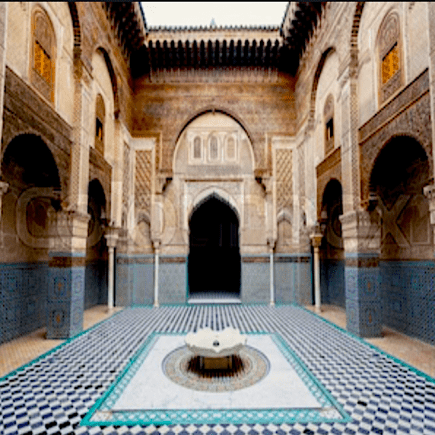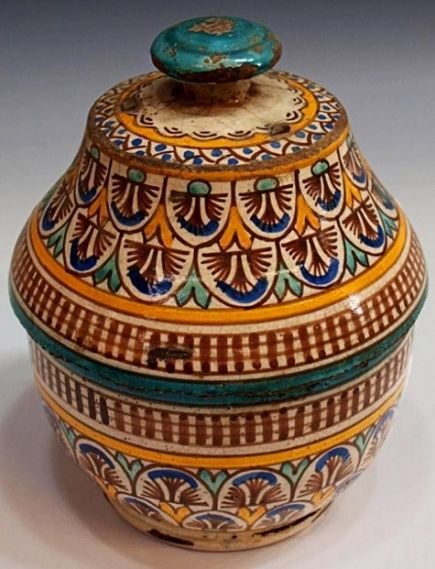
Islamic geometric design mixes elements of math, art, and history. During your trip through Morocco, you will see colorful geometric patterns on mosques, madrasas, palaces, and private homes. Within these contexts, beautiful patterns can be discovered on kilim carpets, zellige tilework, walls, fountains, pillars, the trimmings of front doors, furniture decor, ceilings, stairways, halls, courtyards, and gardens,. Many travelers arriving in Morocco admire the abstract designs yet feel perplexed about the origins and meaning behind the Islamic patterns. As a result, we created a guide to help you understand abstract art and put it into context. You may also want to consider the Al Attarine Madrasa. Fes Islamic geometric design mixes elements of math, art, and history. During your trip through Morocco, you will see colorful geometric patterns on mosques, madrasas, palaces, and private homes. Within these contexts, beautiful patterns can be discovered on kilim carpets, zellige tilework, walls, fountains, pillars, the trimmings of front doors, furniture decor, ceilings, stairways, halls, courtyards, and gardens,. Many travelers arriving in Morocco admire the abstract designs yet feel perplexed about the origins and meaning behind the Islamic patterns. As a result, we created a guide to help you understand abstract art and put it into context.
Historically, Islamic patterns emerged around the 7th century, when craftsmen borrowed designs from the Persian and Roman cultures and adapted them as ornamental decoration in places of Islamic worship. In religious spaces, Islamic art does not represent religious figures as seen in idolatry but instead uses shapes and figures in repetitive patterns and calligraphy to inspire prayer. The abstract repetitions got especially popular during the 8th century Islamic Golden age, a period marked by major achievements in math and science. Sophisticated geometric patterns like floral and vegetal motifs were seen repeating endlessly on carpets, textiles, and tiles designs.
In the twenty-first century, these patterns have taken on new energy in Moroccan interior design. In Morocco’s medinas, geometric patterns can be found in architectural details, shops, and fashion. Riads are renovated and use tilework known as zellige on stairways, wall fountains, interior courtyard floors, walls, and as design accents; ceilings are vaulted and coffered with cedar.
Many Islamic designs are arranged in beautiful patterns called tessellations. There are three common shapes that can form regular tessellations: the equilateral triangle, square, and regular hexagon. Any one of these three shapes can be duplicated infinitely to fill a plane with no gaps. Everything starts with a circle that can be drawn with a compass and split into parts with a ruler. How it is split however will determine the style and design. Most circles are split into 4,5, or 6 equal sections. Each division stylizes the pattern. You can determine if the design is based on 4, 5, or 6 fold symmetry by finding the star in the center of the tile and counting the number of rays and petals around it. A star surrounded by 6 rays belongs in the 6 fold category, a star with 8 petals will have 4 rays and it belongs to the 4 fold category.
Tessellation is based on mathematical elegance. Regardless of how elaborate the designs look, they are always based on hand-drawn grids. Furthermore, Islamic design is based on Greek geometry which has a fundamental belief that complexity can be achieved with simple tools.
Beyond Islamic architecture, tessellation can be found in everyday goods: oriental carpets, quilts, origami, Islamic architecture, and the artwork of M. C. Escher, who made tessellations with irregular interlocking tiles in the shape of animals and natural objects.
Copyright © All Rights Reserved, Design by HC

Discover the World,
Full Adventure at a Time!